Labored breathing in cats is a genuine emergency, and the single most important thing to understand is that a cat working hard to breathe needs a veterinarian now, not in the morning. I want to say that plainly before anything else, because cats are masters at hiding illness, and by the time their breathing visibly struggles, the problem is usually advanced. If your cat is breathing with obvious effort, breathing with its mouth open, or has a bluish tinge to the gums, stop reading and get to an emergency clinic. The rest of this guide will help you recognize trouble early, measure your cat’s breathing at home, understand the common causes, and know exactly what to do on the way to the vet.
My aim here is to give you the calm, specific knowledge that turns panic into action. We will cover what normal breathing looks like, how to spot the red flags, how to count a resting breathing rate yourself, the patterns that hint at different causes, and the conditions most often behind feline respiratory distress.
What Normal Cat Breathing Looks Like
A healthy cat at rest breathes quietly and smoothly, with only a gentle rise and fall of the chest. You should barely notice it. A resting cat normally takes somewhere between 15 and 30 breaths per minute. Breathing should be through the nose, not the mouth, and it should look effortless, without the belly visibly heaving or the shoulders pumping.
Cats do not normally pant the way dogs do. A dog flops down and pants after a run and that is fine. A cat that is open-mouth breathing is almost never doing something normal. The rare exception is a brief stress event, such as a stressful car ride or a hot day right after intense play, and even then the panting should settle within a few minutes once the cat calms and cools. Open-mouth breathing that persists, or that appears at rest, is a warning sign that needs attention.
How to Count Your Cat’s Resting Respiratory Rate at Home
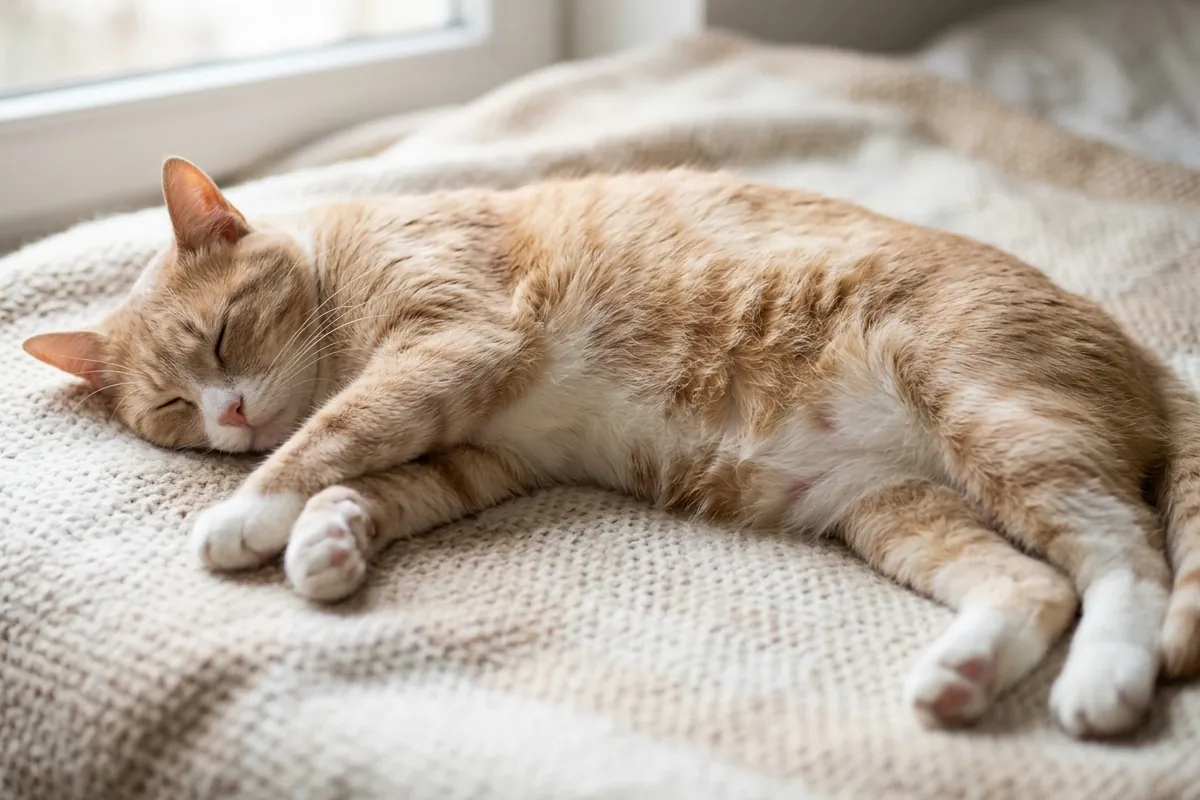
This is the most useful skill in this whole guide, and most articles never teach it. Counting your cat’s resting respiratory rate gives you a hard number instead of a guess, and it is the same measurement veterinarians ask you to track for cats with heart or lung conditions.
Here is the method, drawn from the VCA Hospitals home breathing rate guide:
- Wait until your cat is resting or asleep and, importantly, not purring. Purring throws off the count.
- Watch the chest. One full in-and-out movement counts as a single breath.
- Count the breaths over 30 seconds, then multiply by two. Or count for a full 60 seconds.
- Record the number. A resting rate consistently above 30 breaths per minute is abnormal and warrants a call to your vet.
If you have a cat with a known heart condition, tracking this number a few times a week can catch fluid building up in the lungs before your cat looks sick. A sudden jump in resting rate is often the earliest warning of trouble.
Red Flag Signs That Mean Go Now
Some signs cannot wait. If you see any of these, treat it as a true emergency and head to the nearest open veterinary clinic:
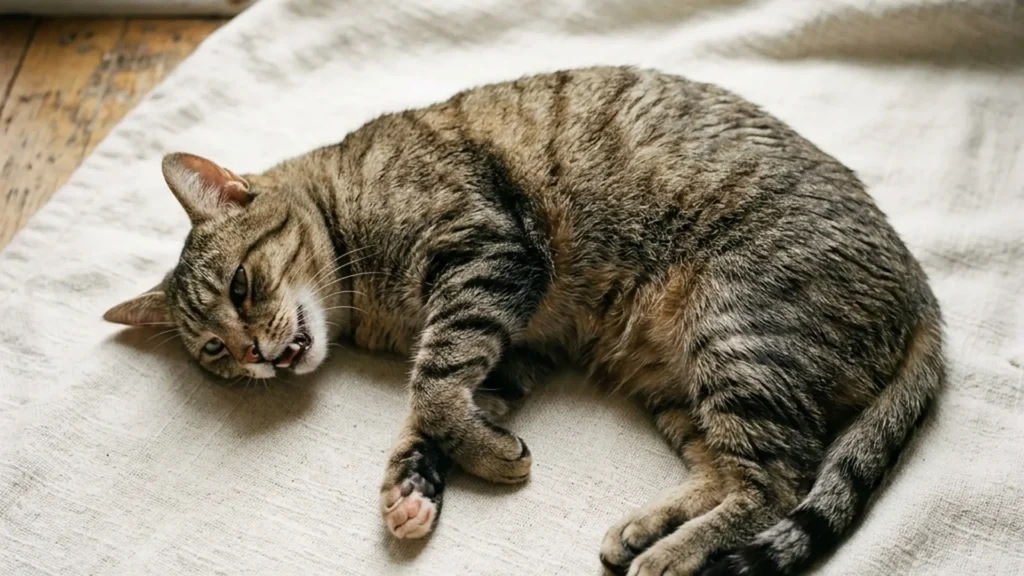
- Open-mouth breathing or panting at rest. Cats breathe through the nose; mouth breathing signals serious distress.
- Blue, gray, or pale gums. This means the body is not getting enough oxygen.
- The belly heaving with each breath or the use of abdominal muscles to force air in and out.
- An extended neck and lowered head, with the elbows held away from the body, a posture cats adopt to open the airway.
- Noisy breathing, wheezing, gurgling, or raspy sounds.
- Rapid breathing at rest, well above 30 breaths per minute, especially if it keeps climbing.
- Collapse, weakness, or hiding combined with any breathing change.
As the Cornell Feline Health Center puts it, any time there is a question about a cat’s ability to breathe comfortably, it should see a veterinarian right away. When in doubt, go. No vet will fault you for bringing in a cat that turns out to be fine.
Reading the Pattern: Where Is the Effort?
This is information the quick guides skip, and it can help you describe what you are seeing to the emergency team, which speeds up care. The effort of labored breathing tends to fall into patterns, and the pattern hints at where the problem is.
Effort on breathing in (inspiratory) often points to a problem in the upper airway, such as a blockage in the throat or windpipe, a foreign object, or laryngeal trouble. You may hear noise as the cat draws air in.
Effort on breathing out (expiratory), sometimes with wheezing and a crouched posture, is classic for lower airway disease like feline asthma, where the small airways narrow and trapping air becomes the struggle.
Rapid, shallow breathing with little chest movement can suggest fluid or air around the lungs, such as pleural effusion, which physically stops the lungs from expanding. These cats often breathe fast and look like they cannot take a satisfying breath.
You do not need to diagnose your cat. You just need to notice and report what you see, because telling the vet that the effort is mostly on the way out, with wheezing, is genuinely helpful triage information.
The Most Common Causes of Labored Breathing
Several conditions account for the majority of feline respiratory emergencies. Here is a quick reference, but remember that only an exam and tests can confirm which one is at play.
| Cause | Typical clues |
|---|---|
| Feline asthma | Wheezing, coughing in a crouched position, effort on exhaling |
| Heart failure (CHF) | Fast resting rate, fluid in lungs, often no cough; can come on suddenly |
| Pleural effusion | Rapid shallow breaths, fluid around lungs limiting expansion |
| Respiratory infection | Congestion, discharge, sneezing, sometimes fever |
| Anemia | Fast breathing, very pale gums, weakness |
| Trauma or pneumothorax | Recent injury, sudden onset, often after a fall or accident |
| Foreign body or tumor | Gradual or sudden airway obstruction, possible gagging |
Metabolic illness can also drive abnormal breathing. A cat in a diabetic crisis, for example, may breathe deeply and rapidly as the body tries to correct its blood chemistry; owners who have read about diabetic ketoacidosis in cats will recognize how a systemic problem can show up as a breathing change. This is one more reason breathing trouble always deserves a full workup rather than a guess.
What to Do Before and During the Trip to the Vet
How you handle a cat in respiratory distress matters, because stress makes breathing worse. A panicking cat that is fighting you uses oxygen it cannot spare. Stay calm and move deliberately.
- Minimize handling. Do not wrestle or over-restrain. Let the cat choose the position it can breathe in best, often sitting upright with the neck extended.
- Use a calm, well-ventilated carrier. A top-loading carrier or one you can open wide lets you place the cat gently without forcing it through a small door. Keep the cat cool.
- Call ahead. Phone the emergency clinic so they are ready with oxygen the moment you arrive. Tell them it is a breathing emergency.
- Drive smoothly and keep the car quiet. Resist the urge to keep checking and disturbing the cat.
- Do not give human medications. Many are toxic to cats, and they will not fix an airway or heart problem.
If your cat collapses, has gone limp, or has blue gums, it is an immediate emergency. Get there as fast as is safe.
Diagnosis and Treatment: What the Vet Will Do
At the clinic, the first priority is usually oxygen, often in a special oxygen cage that lets your cat stabilize before any stressful handling. Once the cat is steadier, the vet may take chest x-rays, listen to the heart and lungs, run bloodwork, and sometimes perform an ultrasound to look for fluid. If there is fluid around the lungs, draining it with a needle can bring fast, dramatic relief.
Treatment then targets the cause. Asthma may be managed with bronchodilators and steroids, sometimes through an inhaler made for cats. Heart failure is treated with medications to clear fluid and support the heart. Infections get appropriate medication. The point is that there is no single fix; identifying the underlying problem is the whole game, and that requires testing. Other systemic illnesses can complicate the picture, which is why a cat with a chronic condition such as feline hyperthyroidism deserves especially careful evaluation when breathing changes appear.
Can You Prevent Labored Breathing?
You cannot prevent every cause, but you can stack the odds in your cat’s favor. Keep up with annual or twice-yearly veterinary exams, because heart disease and asthma are often detectable before they become emergencies. If your cat has a diagnosed heart or lung condition, track that resting respiratory rate at home so you catch a decline early. Keep cats indoors or supervised to avoid trauma. Reduce airborne irritants like smoke, heavy dust, and strong aerosols, which can trigger asthma. And do not skip recommended medications or rechecks for a known condition; consistency is what keeps a managed cat stable.
It is also worth thinking about your own readiness before an emergency ever happens. Know where the nearest 24-hour emergency veterinary clinic is and keep its number saved in your phone, because searching for an open clinic at two in the morning while your cat struggles to breathe is exactly the wrong time to start looking. Keep a sturdy carrier accessible rather than buried in a closet. If you have more than one cat, knowing each one’s normal breathing baseline helps you spot which cat is in trouble and how far it has drifted from its usual self. These small preparations cost nothing and can save crucial minutes.
Labored Breathing vs Coughing vs Hairballs
Owners frequently confuse these three, and the confusion can be dangerous because it leads people to wait when they should act. A cough is a forceful expulsion of air, often with a hacking sound; a cat coughing from asthma will crouch low, extend its neck, and make a dry, repeated hacking noise that people sometimes mistake for trying to bring up a hairball. The difference is that a hairball event ends with the cat actually producing something, while an asthma cough produces nothing but more coughing. If your cat keeps making that crouched, hacking motion without ever producing a hairball, think airway disease, not digestion.
Labored breathing is different again. It is not a single event but an ongoing struggle, visible in the chest and belly with every breath. A cat can cough and also have labored breathing, and that combination is especially concerning. The practical rule I give owners is simple: an occasional cough in an otherwise bright, normally breathing cat warrants a non-urgent vet visit, but any sustained change in the breathing itself, the rate, the effort, or the use of the mouth, moves the situation into the emergency category. When the two appear together, do not wait to see if it passes.
It also helps to know that some cats cough at night or after activity, and that pattern can be easy to dismiss while you are asleep or busy. If you suspect coughing but are not sure, recording a short video on your phone when an episode happens is one of the most useful things you can bring to the vet. Breathing patterns are hard to describe in words, and a clip lets the veterinarian see exactly what is happening, which often shortens the path to a diagnosis.
Special Considerations: Kittens, Seniors, and Flat-Faced Cats
Not every cat carries the same risk, and a few groups deserve extra vigilance. Kittens with upper respiratory infections can deteriorate quickly because their airways are small and their reserves are limited; congestion that would merely annoy an adult can seriously compromise a tiny kitten. If a kitten is breathing with effort, congested to the point of struggling to nurse or eat, or breathing through an open mouth, do not adopt a wait-and-see approach.
Senior cats are the group most likely to develop heart disease and certain cancers, both of which can cause fluid to accumulate around or within the lungs. Because older cats also slow down naturally, owners sometimes attribute early breathing changes to age alone. Resist that assumption. A senior cat whose resting breathing rate has crept up, who tires faster, or who has started sleeping in a more upright, propped position may be showing the first signs of a heart problem, and early evaluation makes a real difference in how well it can be managed.
Flat-faced (brachycephalic) breeds, such as Persians and Himalayans, have compressed airways by design, which can make them noisier breathers at baseline and more prone to trouble in heat or stress. Knowing your individual cat’s normal sound and effort matters even more in these breeds, because the line between their everyday snuffly breathing and genuine distress can be subtle. When you are unsure whether a flat-faced cat has crossed that line, the safe interpretation is to have it checked.
Frequently Asked Questions
Is labored breathing in cats always an emergency?
Treat it as one. Genuine labored breathing, with effort, open-mouth breathing, or color changes in the gums, is a medical emergency that needs immediate veterinary care. Even if it turns out to be manageable, the safe move is to be seen right away.
What is a normal breathing rate for a resting cat?
A resting or sleeping cat normally takes about 15 to 30 breaths per minute. A rate consistently above 30 at rest is abnormal and should prompt a call to your veterinarian.
My cat is breathing fast but seems otherwise fine. Should I worry?
Fast breathing can be caused by stress, heat, or excitement and may settle quickly. If it persists at rest, is accompanied by effort, or comes with any other sign of illness, contact your vet. Counting the resting rate gives you a clearer answer.
Why is open-mouth breathing so serious in cats?
Cats almost always breathe through their nose. Open-mouth breathing, outside of a brief stressful moment that resolves fast, signals that the cat cannot get enough air through normal means and is in distress.
Can stress alone cause heavy breathing in cats?
Short-term stress, like a car ride, can cause brief panting that resolves as the cat calms. Heavy breathing that does not settle, or that appears at rest, is not just stress and needs evaluation.
What should I do while driving my cat to the emergency vet?
Keep the cat calm and minimally handled, let it sit in whatever position helps it breathe, keep the carrier open and cool, call ahead so oxygen is ready, and avoid giving any human medication.
Bottom Line
Labored breathing in cats is one of the few symptoms that should always send you to a veterinarian without delay. Learn what your cat’s calm, quiet breathing looks like, count the resting rate so you have a real number, and act fast at the first sign of effort, open-mouth breathing, or gum color change. Most causes are treatable when caught early, but cats give you little warning, so erring on the side of urgency saves lives. This article offers general guidance and is not a substitute for hands-on care from your own veterinarian.