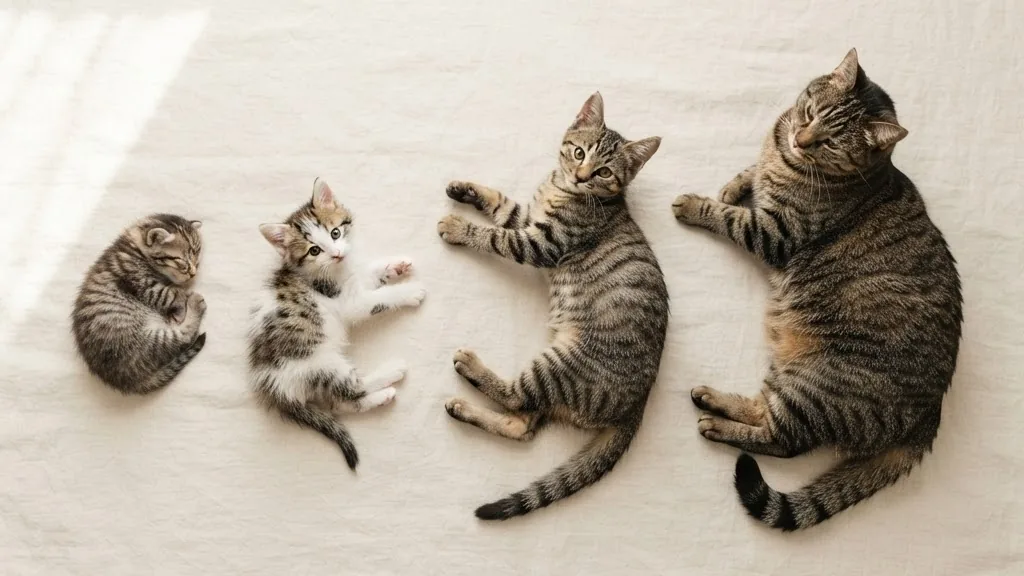
When do cats stop growing? Here is the short answer: most domestic cats reach their adult body size by about 12 months of age, and they finish maturing skeletally by roughly 18 months. Some cats, especially large or slow-maturing breeds like the Maine Coon, keep growing and filling out until they are 3 to 5 years old. So if you are watching a leggy six-month-old kitten and wondering whether that is the final version, the honest answer is almost certainly not yet.
In this guide the Meowlore team walks through the full growth timeline month by month, explains how a cat’s bones actually stop lengthening, breaks down how breed and sex change the picture, gives you real weight ranges to expect, and covers when a growth pattern is worth a call to your veterinarian. This article is educational and is not a substitute for advice from your own veterinarian, who can examine your specific cat and confirm where it is on its growth curve.

The quick answer: when cats stop growing
For the average house cat, the growing is mostly finished by the first birthday. By 12 months, most cats have reached, or come very close to, their adult weight and length. The skeleton takes a little longer to lock into place. Full skeletal maturity, meaning the bones have stopped lengthening and the growth plates have closed, is usually complete by about 18 months.
That gives you a simple two-part rule to remember. Think of 12 months as the point where a cat looks adult-sized, and 18 months as the point where the frame is truly done. After that, any further change in your cat’s outline is about muscle and fat, not new bone length.
There are two important exceptions to keep in mind. First, sex matters: female cats often wrap up their growth a bit earlier, around 10 to 12 months, while males can keep broadening until closer to 18 months. Second, breed matters a great deal. A petite Singapura may be finished by about 9 months, while a Maine Coon is a genuine outlier that can add size for years. We cover both of those below.
How cat growth actually works
To understand when growth stops, it helps to know what is doing the growing. A kitten gets taller and longer because of growth plates, which are bands of soft cartilage near the ends of the long bones in the legs. As the kitten develops, these plates produce new bone, and the bones lengthen. This is the same basic mechanism that lets human children grow taller.
At some point the plates convert entirely to hard bone and close. Once a growth plate has closed, that bone cannot get any longer. In cats, the growth plates generally begin closing around 4 to 5 months of age and are typically fully closed somewhere between 18 and 24 months. That closure window is exactly why the skeleton finishes a little after the cat already looks full grown.
The Merck Veterinary Manual and other veterinary references describe this same physeal (growth plate) process across companion animals. It is also why a veterinarian can sometimes tell whether a young cat is truly done growing by palpating the joints or, more definitively, by taking an X-ray to see whether the growth plates are still open. If the plates are visibly open on a radiograph, there is still growth left in the tank.
Growth timeline, month by month
Kittens grow fast and predictably in the early months, which makes weight a handy tracking tool. A widely used rule of thumb, reflected in the ASPCA kitten weight guidance used by shelters and fosters, is that a healthy kitten gains roughly 1 pound (about 0.45 kg) per month for the first four to five months. So a one-month-old is often near 1 pound, and a four-month-old is often near 4 pounds.
The rate then tapers. By about 6 months, many kittens have reached roughly 75 percent of their eventual adult weight, and by 10 to 12 months most cats are at or very close to their adult weight. The table below shows a typical progression for an average-sized domestic cat. Use it as a general reference, not a strict target, because build and breed shift the numbers.
| Age | Approximate weight | What is happening |
|---|---|---|
| Newborn | 3 to 4 oz (85 to 115 g) | Eyes closed, fully dependent on the queen |
| 1 month | about 1 lb (0.45 kg) | Walking, baby teeth erupting |
| 2 months | about 2 lb (0.9 kg) | Weaned, playing, ready for adoption |
| 3 months | about 3 lb (1.4 kg) | Rapid growth, very active |
| 4 months | about 4 lb (1.8 kg) | Adult teeth starting to replace baby teeth |
| 6 months | about 5 to 6 lb (2.3 to 2.7 kg) | Roughly 75 percent of adult weight; adult teeth nearly in |
| 9 months | about 7 to 8 lb (3.2 to 3.6 kg) | Growth slowing, frame filling out |
| 12 months | about 8 to 10 lb (3.6 to 4.5 kg) | At or near adult size for most breeds |
| 18 months | stable | Skeleton mature, growth plates closed |
If your kitten is tracking a little above or below these figures but is active, eating well, and gaining steadily, that is usually normal variation. What matters more than hitting an exact number is a steady upward trend in the early months and a healthy body condition once growth levels off.
Male versus female differences
Sex is one of the clearest predictors of both final size and finish date. Within any given breed, male cats tend to end up larger than females, and they also tend to take a little longer to get there. Females frequently reach their adult size around 10 to 12 months, while males may keep adding chest, shoulder, and overall bulk until closer to 18 months.
The size gap is most obvious in the larger breeds. In a Maine Coon, for example, an adult male can outweigh an adult female by several pounds. In an average domestic shorthair the difference is smaller but still real, with males often landing a pound or two heavier than females of similar build. None of this is a cause for concern on its own; it is simply the normal pattern of feline development.
Large and slow-maturing breeds
The 12-to-18-month rule holds for most cats, but a handful of breeds break it in the direction of growing longer. The Maine Coon is the headline example. Recognized breed organizations, including the American Kennel Club (AKC) for cat breed profiles and breed-club standards, describe the Maine Coon as one of the largest and slowest-maturing domestic cats. Rather than finishing at a year, many Maine Coons keep gaining size and muscle until they are 3 to 5 years old.
Maine Coons tend to grow in stages. They often add height and length first during the first year, then spend the following years filling out through the chest, shoulders, neck, and overall muscle mass. Males in particular broaden noticeably during this later stretch. Adult Maine Coon males commonly weigh 15 to 25 pounds (about 7 to 11 kg), while females usually land around 10 to 15 pounds (about 4.5 to 7 kg).
Other large or semi-long-haired breeds follow a similar slow curve. Norwegian Forest Cats and Ragdolls, for instance, often continue growing and maturing until roughly 2 to 4 years of age before they reach their full adult frame. If you have one of these breeds, do not assume something is wrong just because your cat is still changing at 18 months. That is the expected timeline for them, not a red flag.
At the other end of the spectrum, smaller breeds finish faster. A Singapura, one of the smallest recognized breeds, may be essentially done growing by about 9 months. Knowing your cat’s breed, or making an educated guess based on its parents if it is a mixed-breed cat, gives you a far better size forecast than any single measurement at a young age.
How big will my cat get? Weight expectations
The average adult domestic cat weighs somewhere around 8 to 10 pounds (about 3.6 to 4.5 kg). That is a midpoint, not a rule. Healthy adult cats range widely, with many males at 8 to 12 pounds and many females at 7.5 to 10 pounds, and breed can push those numbers well outside the average in either direction.
Because the range is so wide, weight alone is a poor way to judge whether a cat is a healthy size. A far better tool, and the one veterinarians rely on, is the body condition score. This is a scale from 1 to 9, where 1 is emaciated, 9 is severely obese, and 5 is ideal. At an ideal score you should be able to feel your cat’s ribs easily under a thin layer of fat, see a visible waist when looking down from above, and see the belly tuck up rather than sag. Two cats can weigh the same and yet have very different body conditions, which is why the score matters more than the scale.
When you are estimating how big a growing kitten will get, the parents are your best clue. Genetics set the frame. If you can see the mother and father, or know the breed, you will predict adult size much more reliably than by looking at paw size or any other early feature.
What affects a cat’s final size
Several factors combine to determine when a cat stops growing and how big it ends up. Understanding them helps you set realistic expectations.
- Breed and genetics. This is the single biggest driver of final size and of how long growth continues. A Maine Coon and a Singapura are on completely different timelines because of their genes.
- Sex. Males are usually larger and take a little longer to finish than females of the same breed.
- Spay or neuter timing. Removing the sex hormones before a cat is fully mature slightly delays growth-plate closure. Counterintuitively, that means altered cats often end up marginally taller or longer, not shorter. The difference is small, on the order of a fraction of an inch, and does not harm the cat. Spaying and neutering do not stunt growth.
- Nutrition. A complete and balanced kitten diet gives a growing cat the protein, calories, and minerals it needs to reach its genetic potential. Underfeeding or an unbalanced diet can hold a kitten back. Overfeeding does not build a bigger frame; it simply adds fat.
- Health. Parasites such as roundworms, congenital problems such as a liver shunt, and diseases affecting the thyroid, kidneys, or heart can all interfere with normal growth.
The American Veterinary Medical Association (AVMA) and the ASPCA both emphasize that routine veterinary care during the first year, including deworming, vaccinations, and nutrition checks, is one of the best ways to keep a kitten on a healthy growth track. Most of the factors that derail growth are easier to catch and correct early.
Kitten food to adult food: the 12-month transition
Growing kittens need more calories, more protein, and specific nutrient ratios than adult cats, which is why kitten (growth) formulas exist. The general guidance is to keep a cat on kitten food until about 12 months, then switch to an adult maintenance diet. Many owners begin the transition somewhere between 10 and 12 months, which lines up neatly with when most cats finish their fastest growth.
The switch should be gradual rather than abrupt. A common approach is to change over across 7 to 10 days by mixing an increasing proportion of adult food into the kitten food each day. A slow transition is gentler on the digestive system and reduces the chance of stomach upset. If your cat does develop digestive trouble during a diet change, our guide to kitten constipation covers what is normal, what is not, and when to act.
Large and slow-maturing breeds are the exception here too. Because a Maine Coon or Norwegian Forest Cat is still growing well past a year, your veterinarian may recommend keeping that cat on a growth formula longer than the standard 12 months. When in doubt, ask your vet to match the diet to your cat’s actual stage rather than to the calendar alone.
How to tell if your cat is still growing
You do not need an X-ray to get a good read on whether your cat is still growing. A few practical signs tell most of the story.
- Track the weight. Weigh your cat every few weeks. If the number is still climbing month over month, the cat is very likely still growing. Once the weight holds steady for several months on a consistent diet, growth has probably finished.
- Watch the frame fill out. Young cats often look lanky and long-legged before they develop the chest and muscle to match. If your cat still looks all legs and no bulk, there is usually more filling out to come, especially in males and large breeds.
- Check the teeth. Kittens have 26 baby (deciduous) teeth, which are replaced by 30 adult teeth. The adult set is usually fully in by around 6 months. Once the adult teeth are complete, the fastest phase of growth is well underway or past. Our overview of how many teeth cats have explains the timeline in more detail.
If you want certainty, your veterinarian can confirm skeletal maturity by feeling the joints or by taking a radiograph to see whether the growth plates are still open. Open plates mean more growth is possible; closed plates mean the skeleton is done.
When to worry: stunted growth and sudden weight change
Most growth questions have reassuring answers, but a few patterns do warrant a veterinary visit. The point of this section is not to alarm you; it is to help you recognize the situations where a professional exam is the right next step.
A kitten that is not growing or is much smaller than its littermates. Stunted growth has several possible causes, and many are treatable if caught early. The most common is an intestinal parasite load, especially roundworms, which steal nutrition from a growing kitten. Malnutrition from underfeeding or an inappropriate diet is another frequent cause. Less common but more serious causes include a congenital portosystemic liver shunt, thyroid or kidney disease, and heart defects that may show up as a murmur along with poor growth and low energy. If a kitten is failing to gain weight, is lethargic, or is falling behind its siblings, have your veterinarian examine it rather than waiting.
Rapid weight gain. A young cat that is gaining weight far faster than the guidelines above, or an adult that is steadily creeping up the scale, is at risk of obesity rather than healthy growth. Extra food does not build a bigger cat; it builds a heavier one. Use the body condition score to judge, and talk to your vet about portion control if your cat is drifting above an ideal score of 5.
Sudden weight loss. Unexpected weight loss in a growing kitten or an adult cat is never something to ignore. It can point to parasites, infection, dental pain, or an underlying medical problem, and it deserves a prompt veterinary visit.
Resources from the Cornell Feline Health Center and the ASPCA are useful general references for kitten and cat health, but they are not a replacement for a hands-on exam. When a growth pattern seems off, your own veterinarian is the right person to make the call. You can learn more about feline health topics through the Cornell Feline Health Center and general pet-care guidance from the ASPCA.
Common myths about cat growth
A few persistent myths cloud this topic. Clearing them up makes it easier to read your own cat accurately.
- Myth: big paws mean a big cat. Paw size is not a reliable predictor of adult size. Some large cats have modest paws and some average cats have chunky feet. Breed and parentage tell you far more.
- Myth: spaying or neutering stunts growth. The opposite is closer to the truth. Altering a cat before maturity slightly delays growth-plate closure, so many altered cats grow marginally taller or longer. The effect is minor and harmless, and it is not a reason to delay a spay or neuter that your veterinarian recommends.
- Myth: feeding more makes a bigger cat. Genetics set the size of the frame. Feeding extra beyond a cat’s needs adds fat, not stature, and pushes the cat toward obesity and its associated health problems.
- Myth: all cats are fully grown at 12 months. True for most, but not for the large slow-maturing breeds. A Maine Coon at a year old is often nowhere near its final size.
The through-line across all of these is the same: breed and genetics, not folk shortcuts, are what determine when a cat stops growing and how large it becomes.
Frequently asked questions
At what age is a cat fully grown?
Most cats reach their adult body size by about 12 months and complete skeletal maturity by roughly 18 months. Large breeds such as the Maine Coon are the main exception and can keep growing until 3 to 5 years of age.
Do male cats grow bigger than female cats?
Yes. Within a given breed, males usually end up larger than females and take a little longer to finish. Females often complete their growth around 10 to 12 months, while males may keep filling out until closer to 18 months.
How much should my cat weigh when fully grown?
The average adult domestic cat weighs about 8 to 10 pounds (3.6 to 4.5 kg), but the healthy range is wide and depends heavily on breed and build. Rather than fixating on the scale, ask your veterinarian to check your cat’s body condition score, where 5 out of 9 is ideal.
Does spaying or neutering stop a cat from growing?
No. Spaying or neutering before maturity actually delays growth-plate closure slightly, so altered cats often grow a fraction of an inch taller or longer, not shorter. It does not stunt growth and is not a reason to postpone the procedure your vet advises.
When should I switch my kitten to adult cat food?
Most kittens move from kitten food to adult food around 12 months, with the transition often starting between 10 and 12 months. Make the change gradually over 7 to 10 days. Large slow-maturing breeds may stay on kitten food longer, so follow your veterinarian’s advice.
Why is my cat so small even though it is an adult?
Some cats are simply small by breed or genetics, which is perfectly normal. But a cat that stayed small because it grew poorly as a kitten may have had parasites such as roundworms, inadequate nutrition, or a condition like a liver shunt. If you are concerned, have your veterinarian evaluate your cat.
How can I tell if my kitten is done growing?
Weigh your cat every few weeks; once the weight holds steady for several months, growth has likely stopped. Adult teeth being fully in by around 6 months and the frame filling out are additional signs. For certainty, a veterinarian can check whether the growth plates have closed by exam or X-ray.