Male cat behavior after neutering shifts in ways that are measurable, not vague, and the clearest data comes from a 1973 study by Benjamin Hart and R. E. Barrett at the University of California, Davis. Following 42 adult male cats castrated in adulthood, they recorded a reduction in fighting of 88 percent, in roaming of 94 percent, and in urine spraying of 87 percent. Those three numbers anchor almost everything an owner wants to know. What follows is the science, the recovery, and the reasons some behaviors stubbornly stay.
Quick answer: After neutering, most male cats spray, roam, and fight far less. Hart and Barrett (1973) documented drops of 87 percent for spraying, 94 percent for roaming, and 88 percent for fighting. Testosterone usually clears within 6 to 8 weeks, so changes are gradual, not instant. Core personality, playfulness, and affection stay the same. Fear-based aggression, learned spraying habits, and anxiety are not hormonal, so neutering does not erase them. Recovery from surgery takes roughly 7 to 10 days.
What Behaviors Actually Change After Neutering
Neutering targets the testosterone-driven behaviors, and the shift shows up first in the four classic problem areas: urine spraying, roaming, inter-male fighting, and sexual behavior toward females. The VCA Animal Hospitals resource on cat behavior reports that spraying is reduced or eliminated in roughly 85 percent of neutered males and that roaming drops in about 90 percent of cases. Hart and Barrett’s field survey put the figures even higher at 87 percent for spraying and 94 percent for roaming. The urine itself also changes: it loses the pungent, musky odor that intact toms use to advertise territory, which is often the first thing owners notice at the litter box.
The behaviors most consistently affected include:
- Urine spraying and marking. Vertical marking on walls, doors, and furniture usually declines within weeks as hormone levels fall.
- Roaming and escape attempts. The drive to patrol a wide territory and find mates weakens sharply, so most neutered cats stay closer to home.
- Inter-male aggression. Fights over females and turf become less frequent, which lowers the risk of bite wounds and abscesses.
- Mounting and pursuit of females. Sexual attraction diminishes, though it may not vanish entirely.
One practical benefit compounds the rest. Fewer fights means fewer puncture wounds, and puncture wounds are the main route by which feline leukemia virus and feline immunodeficiency virus spread between roaming toms.
Two other, less-discussed behaviors also fade once testosterone drops. The first is loud, repetitive yowling aimed at attracting females in heat, which is common in unneutered males living near intact females outdoors or in multi-cat households. The second is a reduced tendency to back up to vertical surfaces before spraying, a posture that is itself part of the marking ritual rather than ordinary urination. Owners sometimes describe watching this posture disappear gradually over the weeks after surgery rather than all at once, which matches the same 6 to 8 week hormone-clearance window that governs spraying and roaming.
It also helps to understand what neutering does physically. The procedure removes the testicles, which are the primary source of circulating testosterone in a male cat. Without that hormone supply, the behaviors it fuels lose their driver over time, but the brain circuitry that once responded to the hormone does not disappear instantly, which is part of why some responses fade gradually rather than switching off like a light.

What Does Not Change: Personality Stays Intact
Neutering does not rewrite who your cat is, and this is the single most common worry among owners. According to the VCA Animal Hospitals resource, castration acts only on sexually dimorphic behaviors, and it does not reduce anxiety or curb hyperactivity. A playful, chatty, lap-seeking cat stays playful, chatty, and lap-seeking. His baseline energy, his hunting drive, his affection, and his quirks are not hormone-dependent, so they survive the surgery untouched.
Here is the biological reason it works this way. The male cat’s brain is masculinized before birth, so the neural wiring for certain sexual and social behaviors is already laid down by the time he is a kitten. Removing the testicles removes the ongoing testosterone supply, but it cannot un-wire a brain that developed in the womb.
What stays the same or is unaffected by neutering:
- Core temperament, sociability, and the way he bonds with you.
- Play behavior, prey drive, and general activity level.
- Fear-based or territorial aggression that is not rooted in hormones.
- Anxiety and overactivity, neither of which castration reduces.
Owners sometimes describe a calmer cat, but that calm usually reflects fewer hormonal urges to fight and roam, not a dulled or depressed animal. He is not sedated. He is simply less driven to do the risky things testosterone once pushed him toward.
Consider two owners with cats of similar age and breed. One neuters at four months, before any spraying habit forms, and describes no real personality shift at all beyond a slightly calmer household once the cat matures. The other waits until the cat is two years old and has already sprayed a hallway for a year. That second owner is far more likely to see lingering marking even after the surgery, not because the surgery failed, but because a learned pattern layered itself on top of the hormonal one. The underlying temperament in both cats stays the same; only the hormone-driven layer of behavior responds to the surgery.
The Recovery Timeline: When Behavior Actually Shifts
Testosterone does not vanish the moment the surgery ends, and this single fact explains most owner confusion. Hormone levels fall gradually, and behavior generally follows over the course of 6 to 8 weeks. Some cats show a rapid drop-off within days, while others taper down over weeks to months, which matches the two decline patterns Hart and Barrett described in their original cohort. A cat neutered young, before habits set in, tends to change faster than an older tom with years of ingrained behavior.
The table below separates the medical recovery window from the behavioral clearance window, because they run on different clocks.
| Window | What happens |
|---|---|
| Surgical recovery | Incision heals, activity restricted, e-collar worn |
| Testosterone clearance | Spraying, roaming, fighting begin to fall |
| Entrenched habits | Learned behaviors may linger past hormone drop |
Age at surgery matters more than most guides admit. A prepubertal kitten neutered before he ever sprayed rarely develops the habit at all. An adult male who has sprayed the same doorframe for two years may keep doing it out of learned routine even after his testosterone is gone. If you are still weighing the right moment for the procedure, our vet-backed guide on how old cats should be to get fixed breaks down the age windows and their trade-offs. The take-home is that earlier surgery generally means faster, cleaner behavioral results.
Within that 6 to 8 week window, expect the decline to be uneven rather than a straight line. Roaming and mounting behaviors tend to drop first, often within the first two to three weeks, because they respond most directly to the hormone drop. Spraying frequency, especially if it has become habitual, can lag behind by several additional weeks. Fighting frequency depends heavily on whether other intact males are present in the environment; a neutered cat living alongside an intact tom next door may still get drawn into conflict even after his own hormone levels have cleared, simply because the other cat is still initiating.
Indoor vs Outdoor Neutered Males: Does the Environment Matter
The Hart and Barrett figures describe average outcomes, but where a cat lives changes how visible those outcomes are. An indoor-only male has fewer opportunities to roam in the first place, so the 94 percent roaming reduction is harder to observe directly, though the underlying drive still falls. An outdoor or indoor-outdoor male shows the change much more clearly, since his territory, patrol routes, and encounters with rival toms shrink noticeably within weeks of surgery.
Spraying tells a similar story. Indoor cats that spray are almost always responding to an indoor trigger, whether that is a window view of another cat, a new pet in the home, or a change in the litter box setup, so the hormonal component of the behavior can be masked by an environmental one. Outdoor cats that spray around the yard or porch are more directly reflecting territorial marking, which is exactly what neutering is designed to reduce. This is one reason two owners can compare notes on their neutered cats and come away with very different impressions of how much the surgery changed.
Post-Surgery Care and the Red Flags That Mean Call the Vet
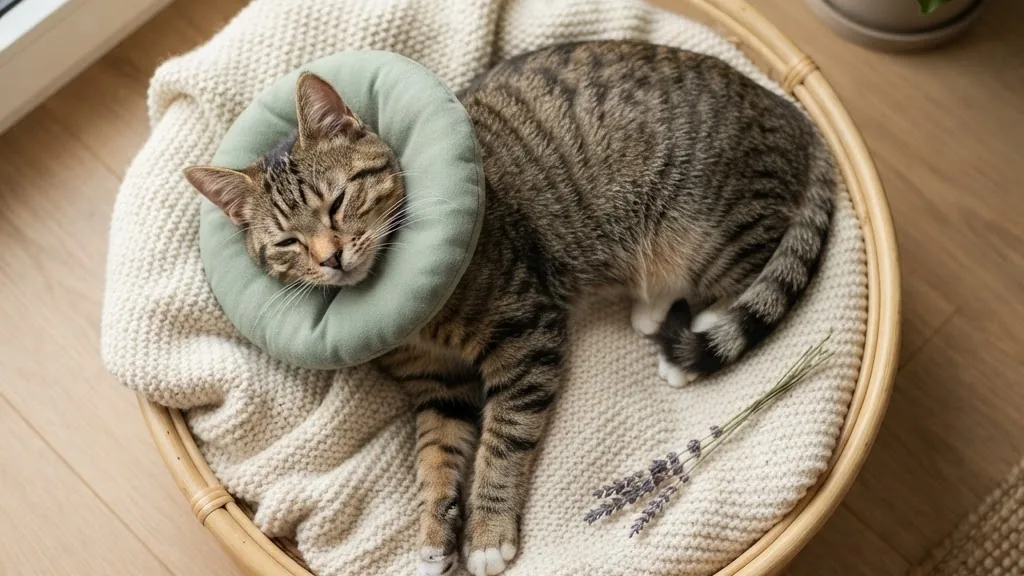
The days after neutering are about protecting the incision and reading your cat’s body for warning signs. Most male cats bounce back quickly because a castration is less invasive than an abdominal spay, but the recovery still demands attention. Your cat will usually wear an e-collar or recovery cone to stop him licking the site, and vets typically recommend switching to a non-clumping, low-dust litter for about a week so fine granules do not stick to the wound. Keep him calm and indoors, restrict jumping and rough play, and give any prescribed pain medication exactly as directed rather than reaching for human painkillers.
Some post-op grogginess and reduced appetite on day one are normal. What is not normal deserves a phone call.
Contact your veterinarian promptly if you see:
- Swelling, redness, or discharge at or around the scrotal incision beyond mild bruising.
- Persistent lethargy that does not resolve on its own.
- No urination, straining, or crying in the litter box, which can signal a serious blockage.
- Obsessive licking that reopens the site, or a wound that will not close.
Urinary trouble deserves special vigilance in male cats because their narrow urethra makes them prone to obstruction. If your cat strains without producing urine, treat it as an emergency and review the cat urinary blockage symptoms every owner must recognize fast so you know exactly what you are looking at. A blocked male cat can deteriorate within hours, and it is unrelated to the neutering itself but easy to confuse with post-op discomfort.
Cone compliance is one of the most common practical struggles in the first week. If your cat fights the e-collar constantly, try a softer inflatable collar as an alternative, cover any sharp furniture edges he might bump into, and supervise short cone-free periods only while you watch him directly, then put it back on before leaving the room. Never leave a cat unsupervised without the cone during the first several days unless your veterinarian has specifically cleared it, since a single bout of licking can undo the healing that has already taken place.
Activity restriction is the other piece owners underestimate. Jumping onto counters or cat trees puts strain on the incision and can cause swelling or reopening even when the cat otherwise seems fine. Confining him to a single quiet room with a low litter box, food, and water for the first several days removes the temptation and makes healing far more predictable.
Still Spraying or Fighting After Neutering? Here Is Why
When a neutered cat keeps spraying or fighting, the surgery did not fail, and understanding why depends on separating three different drivers of behavior. The first is hormonal, and that is what neutering addresses. The second is learned, where a behavior that began as a hormone-driven urge has hardened into a habit that outlives the hormones. The third is fear or stress, which was never hormonal to begin with. The VCA resource is explicit that castration does not reduce anxiety, so a cat spraying because a new pet or a neighbor’s tom is stressing him will keep spraying regardless of his testosterone level.
This is the gap that leaves so many owners feeling cheated. A share of neutered males continue to spray, which lines up with the 85 to 90 percent success figures rather than contradicting them.
Common reasons behavior persists after surgery:
- Late neutering. An adult tom with years of spraying has built a motor habit that hormone loss alone will not undo.
- Learned association. The cat sprays a specific location out of routine, not sexual drive.
- Environmental stress. Outdoor cats, household conflict, or resource competition trigger stress marking.
- Redirected aggression. Frustration aimed at a person or another pet is behavioral, not hormonal, and can persist.
Dr. Sharon Crowell-Davis, a veterinary behaviorist at the University of Georgia, has long emphasized that inter-male aggression is multifactorial, which is a clinical way of saying hormones are one input among several. That framing matters for owners: if your cat is still reactive after his testosterone has cleared, the answer is usually a behavioral or environmental plan, not a second look at the surgery.
If spraying continues past the 8 week hormone window, a practical troubleshooting sequence works better than guessing. First, rule out a medical cause by having your vet check for a urinary tract infection or bladder issue, since painful urination can look like spraying. Second, identify the trigger by noting exactly where and when the marking happens, since a location near a window or a shared litter box points to stress rather than hormones. Third, address the environment directly by adding litter boxes, cleaning marked areas with an enzymatic cleaner rather than an ammonia-based one, and reducing visual access to outdoor cats through window film or furniture placement. Only after these steps should you consider whether the behavior is simply an old habit that will fade slowly on its own.

Weight Gain After Neutering and How to Manage the Ration
Weight gain is the most predictable side effect of neutering, and it stems from a real metabolic change rather than from laziness. After the testicles are removed, a cat’s energy requirements fall while his appetite often rises, so the same bowl of food that kept him lean before surgery now tips him toward excess weight. This is not a reason to skip neutering, and it is entirely manageable, but it does mean the feeding routine that worked for an intact tom needs adjusting once he is neutered.
The practical fix is portion control and monitoring rather than guesswork. Weigh your cat’s food, watch his body condition, and talk to your veterinarian about reducing the ration once he has healed. A cat that is filling out normally as he matures is different from one gaining fat, and knowing when cats stop growing and how weight changes with age helps you tell the two apart. Steady frame growth in a young cat is expected. A widening waistline in a neutered adult is a signal to trim calories.
Keep weight in check with a few habits:
- Measure meals instead of free-feeding once he is fully recovered.
- Favor interactive play and food puzzles to keep his activity up.
- Check his body condition monthly by feeling for the ribs and waist.
- Ask your vet about a formula suited to neutered adult cats.
Many veterinarians suggest reducing daily calories compared to what an intact male of the same size ate, then adjusting up or down based on monthly weigh-ins. Because the metabolic slowdown is gradual rather than immediate, the best window to start watching portions closely is the same 6 to 8 week period during which behavior is also settling, since that is when the calorie need actually drops.
The Bigger Picture: Health, Shelters, and Responsibility
Neutering pays dividends that reach well beyond the litter box, and the population data make the case plainly. Unplanned litters from unaltered males and females remain a major driver of cats entering shelters across the United States. A single roaming intact tom can father many litters across a neighborhood in a season, so neutering one cat prevents a cascade of unwanted kittens. The American Veterinary Medical Association backs spaying and neutering as tools for reducing pet overpopulation and preventing unwanted litters.
The individual health gains are just as concrete. Fewer fights mean fewer abscesses and a lower risk of the blood-borne viruses that spread through bite wounds. Removing the testicles eliminates the risk of testicular cancer entirely.
There are a few less common medical scenarios worth knowing about. A cryptorchid cat, meaning one whose testicle or testicles never fully descended into the scrotum, still needs surgery to remove the retained testicle, since it continues producing testosterone and carries a higher long-term cancer risk if left in place. This surgery is more involved than a standard neuter and may require abdominal exploration, so it typically costs more and involves a longer recovery. If your cat was neutered late in life, past full sexual maturity, expect the behavioral improvements described here to still occur, just more slowly and sometimes less completely than in a cat neutered before or shortly after puberty.
The organizations worth knowing as you weigh the decision include:
- American Veterinary Medical Association, which publishes the profession’s position on spaying and neutering for pet owners.
- ASPCA, which maintains guidance on when to spay or neuter your pet and tracks national shelter intake.
- American Association of Feline Practitioners, which sets feline-specific clinical guidelines.
- American Animal Hospital Association, which issues clinical guidelines used across accredited practices.
For a science-first summary of the behavioral outcomes, the VCA Animal Hospitals overview on cat neutering and behavior is a reliable reference, and the primary source itself sits in the veterinary literature as the Hart and Barrett paper indexed on the effects of castration on fighting, roaming, and urine spraying. International Cat Care and the American Association of Feline Practitioners both reinforce the same practical message: neuter early, feed for the new metabolism, and judge behavior on the 6-to-8-week hormone clock rather than expecting an overnight change.
Common Myths Worth Retiring
A few misconceptions persist because they sound plausible even though they do not match the evidence. The first is that neutering makes a cat lazy or depressed. What actually happens is a drop in hormone-driven roaming and fighting, which can look like less activity but is really just less risk-taking; play drive and general energy are unaffected. The second myth is that a cat’s personality will change entirely, when in fact only the sexually dimorphic behaviors shift, while sociability, affection, and quirks remain the same cat you knew before surgery.
A third myth is that neutering will fix aggression toward people or other pets. It reduces inter-male aggression tied to competition over mates and territory, but fear-based or redirected aggression toward humans needs its own behavioral plan, since it was never driven by testosterone in the first place. A fourth myth worth retiring is that waiting until adulthood gives a cat a chance to develop naturally before surgery. In practice, waiting only gives hormone-driven habits like spraying more time to become learned routines that persist after the hormones themselves are gone.
Frequently Asked Questions
How long after neutering will my male cat calm down?
Testosterone clears gradually, so expect changes over roughly 6 to 8 weeks rather than overnight. Some cats settle within days, while older toms with ingrained habits may take weeks to months. Hart and Barrett documented both rapid and gradual decline patterns, so a slow shift is normal and does not mean the surgery failed.
Why is my cat still spraying after being neutered?
A minority of neutered males keep spraying, matching the 85 to 90 percent success rate. Persistent spraying is usually learned habit or stress rather than hormones. Late-neutered adults, environmental conflict, or a rival cat outdoors can all trigger marking. The VCA resource notes castration does not reduce anxiety, so stress marking needs a behavioral fix.
Does neutering change my cat’s personality?
No. Neutering acts only on sexually dimorphic behaviors like spraying, roaming, and inter-male fighting. Core temperament, playfulness, affection, and energy are not hormone-dependent, so they stay intact. The male brain is masculinized before birth, which is why personality survives the surgery and your cat remains recognizably himself afterward.
Will my cat get fat after being neutered?
Weight gain is common because energy needs fall while appetite often rises. It is manageable with portion control rather than free-feeding, monthly body-condition checks, and regular play. Ask your veterinarian about a diet suited to neutered adults, and adjust the ration once your cat has fully recovered from surgery.
How long does neutering surgery recovery take?
Most male cats recover from the incision within about 7 to 10 days. Keep him calm and indoors, use a low-dust non-clumping litter for roughly a week, and keep the e-collar on to prevent licking. Call your vet for swelling, redness, ongoing lethargy, or any failure to urinate.
Does neutering reduce aggression toward people?
Not reliably. Neutering lowers inter-male aggression tied to hormones, but fear-based, territorial, and redirected aggression toward people are not hormonal. Dr. Sharon Crowell-Davis has emphasized that inter-male aggression is multifactorial, so hormone loss is only one factor. Aggression aimed at humans usually needs a behavioral and environmental plan.
Does the age at neutering really change the outcome?
Yes. A cat neutered before puberty rarely develops spraying or roaming habits in the first place, so the behavioral results tend to be faster and more complete. A cat neutered as an adult, especially one with years of established marking or fighting behavior, can still improve substantially, but learned habits may partially persist even after his testosterone has fully cleared.
The Bottom Line
The evidence on neutering is unusually consistent for a behavior question. Fighting, roaming, and spraying fall sharply, by 88, 94, and 87 percent respectively in the foundational Hart and Barrett work, while personality and affection stay put. Behavior change takes time, recovery from surgery is generally straightforward, and cats who keep spraying afterward are almost always driven by habit or stress rather than a failed operation. Feed for the slower metabolism, watch for the red flags, and give the hormones time to clear.
Neutering is a sensitive medical decision, and the guidance here is educational rather than a substitute for your own veterinarian, who knows your individual cat.